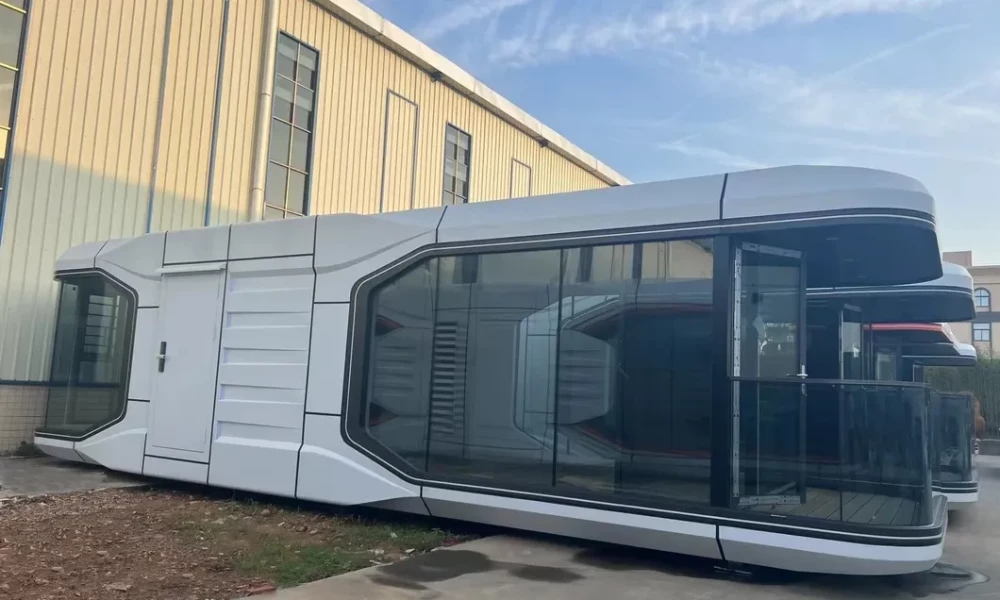
As of 2026, a 20 m² capsule hotel key costs $57,000–$72,000 all-in on a US site at 12 keys, and $45,000–$57,000 at 36 keys. That covers the unit delivered and installed, its utilities, a share of shared facilities, soft costs and contingency. The HVS 2026 US survey puts limited-service hotels at $170,000–$197,000 per key.
Two projects buying identical units can land 30% apart per key, and the difference is rarely the capsule. It is how many keys share one reception, one waste system, one permit set and one crane visit. Cost per key is a division problem before it is a purchasing problem, and the divisor is the first decision a developer makes.
What cost per key measures, and what it hides
Cost per key is total development cost divided by guest rooms. The figure only means something when the scope behind it is stated, because published benchmarks differ by a factor of three on whether they include land, FF&E, financing and pre-opening costs. This article uses one scope throughout: land excluded, soft costs included, which is the basis the industry surveys use when they report a number excluding land.
Five lines go into it:
The unit, delivered to site and set on its foundation
Utilities to each unit: water, waste, power, sub-panel
Shared facilities: reception, decking, site power upgrade, waste system, lighting, signage, landscaping
Soft costs: design, structural and energy calculations, plan review, permit fees, fire strategy
FF&E, operating supplies, and contingency
The line most often missing from a comparison is the third. On a 10-key pod property it can equal half the cost of the units. A figure built from a factory quotation plus a freight estimate is not a per-key number; it is a unit price with a shipping estimate attached.
We keep the project-level view in our guide to starting a capsule hotel and the FOB mechanics in the space capsule house price guide. This piece sits between them: the arithmetic that turns a unit price into a per-key development cost.
The per-key build-up for a 12-key property
Take a 12-key site on flat ground with power and water at the boundary, using the 20 m² M10 as the room. The unit is the 5.8 m flat-pack with wet core, kitchenette and climate control, and its delivered-and-installed band is $29,000–$33,000 on the US West Coast. Everything else is site work priced by the address, not by the supplier.
| Line, per key | 2026 range | Basis |
|---|---|---|
| Unit, delivered and installed | $29,000–$33,000 | 20 m² M10 on screw piles, incl. freight, duty, crane |
| Utilities to the unit | $3,000–$6,000 | Water, waste, power lateral, sub-panel; trench at $40–$85/lf |
| Shared facilities | $12,000–$14,000 | ~$150,000–$170,000 fixed, divided by 12 keys |
| Soft costs | $6,000–$8,000 | ~$75,000–$95,000 fixed: design, calcs, permits |
| FF&E and OS&E | $3,000–$5,000 | Bed, linen, towels, kitchen kit, signage per room |
| Contingency at 8–10% | $4,000–$6,000 | Subsurface, utility upgrades, jurisdictional comments |
| All-in per key | $57,000–$72,000 | Land excluded |
| 12 keys, total | $684,000–$864,000 | Before land and working capital |
The shared line deserves a note. A pod property still needs an arrival point, a check-in desk, a bin store and enough electrical capacity for 12 air conditioners at once. A 200 A service upgrade runs $2,500–$4,500, a reception pod is a unit in its own right, and decking is priced per square metre of site rather than per room.
Soft costs behave the same way: the structural calculations, energy documentation and permit set are mostly one package whether you place 10 units or 30. Fire separation and egress will be examined closely for any property sleeping guests commercially, and the classification that applies is a local decision. Our units are engineered to meet typical requirements for wind, snow and seismic loading, with documentation supplied for your engineer of record — confirm the applicable classification and life-safety requirements with your local authority before you order.
Cost per key by model, and the container maths
Room size moves the per-key number one way and the per-square-metre number the other. A wet core, a kitchenette, an entry door and a climate unit cost roughly the same on a 20 m² shell as on a 42 m² shell, so the larger unit is cheaper per square metre and dearer per key.
| Model | Floor area | Unit delivered and installed | All-in per key at 12 keys | All-in per m² |
|---|---|---|---|---|
| M10 flat-pack, 5.8 m | 20 m² | $29,000–$33,000 | $57,000–$72,000 | $2,850–$3,600 |
| M30, 9 m | 24.5 m² | $37,000–$40,000 | $66,000–$80,000 | $2,650–$3,270 |
| M50, 10 m | 30 m² | $38,500–$43,000 | $68,000–$84,000 | $2,230–$2,800 |
| M42, 12 m | 42 m² | $50,000–$56,000 | $81,000–$98,000 | $1,900–$2,330 |
Which row you pick is a density question. Twelve 20 m² keys need 240 m² of built area; twelve 42 m² keys need 504 m² and change the site plan, the shared facility sizing and often the planning classification. A capsule concept is built on the first row. The 42 m² unit belongs in a resort or family-suite product, and the size guide from M10 to M70 sets out the envelopes.
Freight and duty sit inside the delivered line, but they behave differently per model: duty is a percentage of FOB, freight is a share of a container.
| Model | Kits per 40HQ | Freight per key | FOB per unit | Duty per key at 40.4% |
|---|---|---|---|---|
| M10, 20 m² | 2–3 | $2,300–$3,400 | $11,800–$17,500 | $4,770–$7,070 |
| M30, 24.5 m² | 2 | $3,400 | $15,500–$19,500 | $6,260–$7,880 |
| M50, 30 m² | 2 | $3,400 | $17,000–$24,000 | $6,870–$9,700 |
| M42, 42 m² | 1 | $6,800 | $21,000–$33,000 | $8,480–$13,330 |
Freight is modelled at $6,800 per 40HQ. Spot rates have moved through a wide band in 2026: Drewry's World Container Index assessed Shanghai–Los Angeles at $7,514 per FEU on 29 October 2026, while forwarder all-in quotes earlier in the year sat nearer $2,700–$5,500. A freight figure older than a week is a planning assumption, not a price.
Duty is larger and more stable. Steel modular units have been classified under HTS 9406.20 at 2.9% MFN, and the China-specific measures have changed repeatedly since 2018. At late-2026 rates that is 2.9% MFN plus 25% Section 301 plus a 12.5% Chapter 99 surcharge, or 40.4% of FOB. On the 20 m² unit at $14,200 FOB that is $5,737 — more than the freight and more than the foundation. Get the classification and Chapter 99 treatment confirmed in writing by your broker before the deposit; a classification error on a 24-key order is a five-figure surprise.
The container also sets a physical limit. A 40HQ measures 12.03 m × 2.35 m × 2.69 m internally, with a 2,340 mm × 2,585 mm door aperture and 26,000–28,000 kg payload. A flat-packed 20 m² kit loads two to three per box. An assembled 12 m unit leaves 30 mm inside the container and cannot pass the door, so the 42 m² models ship flat-packed and carry a whole container each.
How key count changes the number
The arithmetic is the most useful thing a developer can put in a spreadsheet: per-key cost equals the variable cost per key plus the fixed site cost divided by the number of keys.
For the 20 m² model above, the variable line is $35,000–$44,000 per key (unit, utilities, FF&E). The fixed line — shared facilities plus soft costs — is $225,000–$265,000 for the property. Divide it by the key count and add it back:
| Key count | Fixed cost per key | All-in per key | Total development cost |
|---|---|---|---|
| 10 keys | $22,500–$26,500 | $62,000–$78,000 | $620,000–$780,000 |
| 12 keys | $18,750–$22,100 | $57,000–$72,000 | $684,000–$864,000 |
| 24 keys | $9,400–$11,000 | $48,000–$61,000 | $1,152,000–$1,464,000 |
| 36 keys | $6,250–$7,400 | $45,000–$57,000 | $1,620,000–$2,052,000 |
Going from 10 keys to 36 cuts the per-key number by roughly a quarter without changing a single unit specification. That is the whole economic argument for phasing on one site rather than opening three small sites, and it is why a 10-key project should not be judged against a 30-key benchmark.
Phasing has a cost of its own: a second phase re-mobilises the crane, re-runs trenching and may need a permit amendment. If the site will grow, size the electrical service, waste system and access road for the final key count on day one. Cheap to oversize now, expensive to revisit.
What moves the per-key cost most
Five decisions account for most of the spread inside these ranges, and each is cheaper before production than after.
Shell insulation. 80 mm polyurethane in the walls is what we ship as standard. Dropping to 50 mm saves about $4,000 on a unit and buys it back as heating load and condensation on the interior face at the studs.
Glazing. Glass is 20–30% of the envelope. Double glazing in a thermal-break frame is the baseline; Low-E or triple glazing adds cost and pays back in cooling load in hot climates and heating load in cold ones. Single panes in an aluminium channel undo the wall specification.
Private wet core. A bathroom inside the unit is the largest single item in the room cost and the largest driver of rate. Shared bathrooms move that cost into the shared facility, where it divides across keys — and where guest complaints concentrate.
Deck, awning, paving. $2,500–$6,000 per key, the item most often left out of an estimate, and the one guests photograph.
Climate specification. A heat pump sized for the local design temperature adds $1,200–$2,500 per key over an undersized unit and removes the most common cause of a bad review in a sealed shell.
Standardisation sits alongside those. Every extra shell length adds a production setup, a loading plan and a spare-parts line. One room type plus one suite type is cheaper to build, cheaper to furnish and faster to open than the same key count across five layouts.
How the number compares with hotel benchmarks
A capsule key is not a hotel key, and the comparison only holds if you are explicit about what is missing: no corridors, no lifts, no back-of-house, no restaurant, and a smaller room. What it does show is the size of the gap a pod format opens.
| Basis, 2026, land excluded unless stated | Cost per key | Source |
|---|---|---|
| Limited-service and midscale extended-stay | $170,000–$197,000 | HVS 2026 US Hotel Development Cost Survey |
| Select-service | ~$200,000 | HVS 2026 |
| Upscale extended-stay | ~$265,000 | HVS 2026 |
| Full-service | ~$467,000 | HVS 2026 |
| All surveyed properties, median | ~$213,000 | HVS 2026, published July 2026 |
| Volumetric select-service module only | $145,000–$185,000 | 2026 US volumetric pricing, $185–$245/sq ft |
| Container hotel, all-in planning range | $125,000–$300,000 | Published 2026 feasibility guidance |
| 20 m² pod key, 12-key property | $57,000–$72,000 | This model |
Read the last three rows together. A volumetric module at $145,000–$185,000 per key is a brand-standard guest room inside a building; a container hotel budgeted at $125,000–$300,000 all-in is a full property including the public areas that make it a hotel. A 20 m² pod at $57,000–$72,000 is a smaller, simpler product on a smaller site, and it belongs beside a cabin, a glamping unit or an extended-stay suite rather than a branded select-service room. A published Australian capsule budget puts a one-bedroom capsule at A$120,000–$165,000 per key all-in, with local approval and labour costs explaining most of that gap.
Three numbers to confirm before you pay a deposit
Everything above is a planning figure built from published site costs and the late-2026 rate environment. Before a deposit, three inputs should become documents.
Freight, dated. Ask for a quote with a validity date and the container count it assumes. Twenty-four keys is 12 containers at two kits each, and the rate on 12 boxes is worth negotiating separately from the rate on one.
Duty, classified. Ask your broker for the HTS classification and Chapter 99 treatment in writing, with duty as a percentage of FOB. This is the line where a mistake compounds across every key on the site.
Fixed scope, planned. Ask for a site plan showing where shared facilities sit, what the electrical service is sized to, and which trenches are shared between units. That is what turns a $225,000–$265,000 range into a number.
On timing, the sequence is short by construction standards: about 15 working days of production for a standard order, 14–20 days of ocean transit to the US West Coast, one to two weeks of port, drayage and crane work, then 2–3 days of assembly per unit with a crew of 3–4. A 12-key property with permits and pads ready can be taking bookings inside a quarter.
Send us your key count, site plan and target opening date, and we will return a per-key worksheet with those five lines filled in for your site, plus a container loading plan.
Frequently asked questions
What is a realistic cost per key for a capsule hotel in 2026?
$57,000–$72,000 per key for a 20 m² unit on a 12-key US site, land excluded, including utilities, shared facilities, soft costs and contingency. At 36 keys the same specification lands at $45,000–$57,000 because the fixed site costs divide across more rooms.
Does a lower FOB price reduce cost per key?
Less than most buyers expect. On a 20 m² unit at $14,200 FOB, freight and duty add about $9,100, and fixed site costs add $18,750–$22,100 more at 12 keys. A 10% saving on the unit is worth roughly $1,400 per key; loading three kits per container instead of two is worth $1,100. Negotiate the loading plan before the unit price.
How many capsule units fit in a 40HQ container?
Two to three flat-packed 20 m² kits per 40HQ, two 24.5 m² or 30 m² kits, and one 42 m² kit. The 12 m shell cannot pass the 2,340 mm door aperture assembled, so it ships flat-packed and carries a whole container alone, which roughly doubles freight per key at that size.
How long does it take from deposit to opening night?
About 15 working days of production, 14–20 days of ocean transit to the US West Coast, one to two weeks of port, drayage and crane work, and 2–3 days of assembly per unit with a crew of 3–4. Most 12-key projects open 10–12 weeks after deposit if site work and permits are already in hand.
What does the per-key number exclude?
Land or lease cost, financing and interest carry, pre-opening staffing and marketing, and working capital. It also excludes anything a site visit would reveal: retaining walls on a slope, an extended utility run, or a fire access road.
Do these units need building approval as hotel rooms?
A prefabricated module is usually still a building under local planning law, so the same permits, fire safety and accessibility requirements apply as for site-built rooms. Our units are engineered to meet typical structural requirements and ship with documentation for your engineer of record; the applicable classification, egress and accessibility requirements must be confirmed with your local authority before you commit to a site.