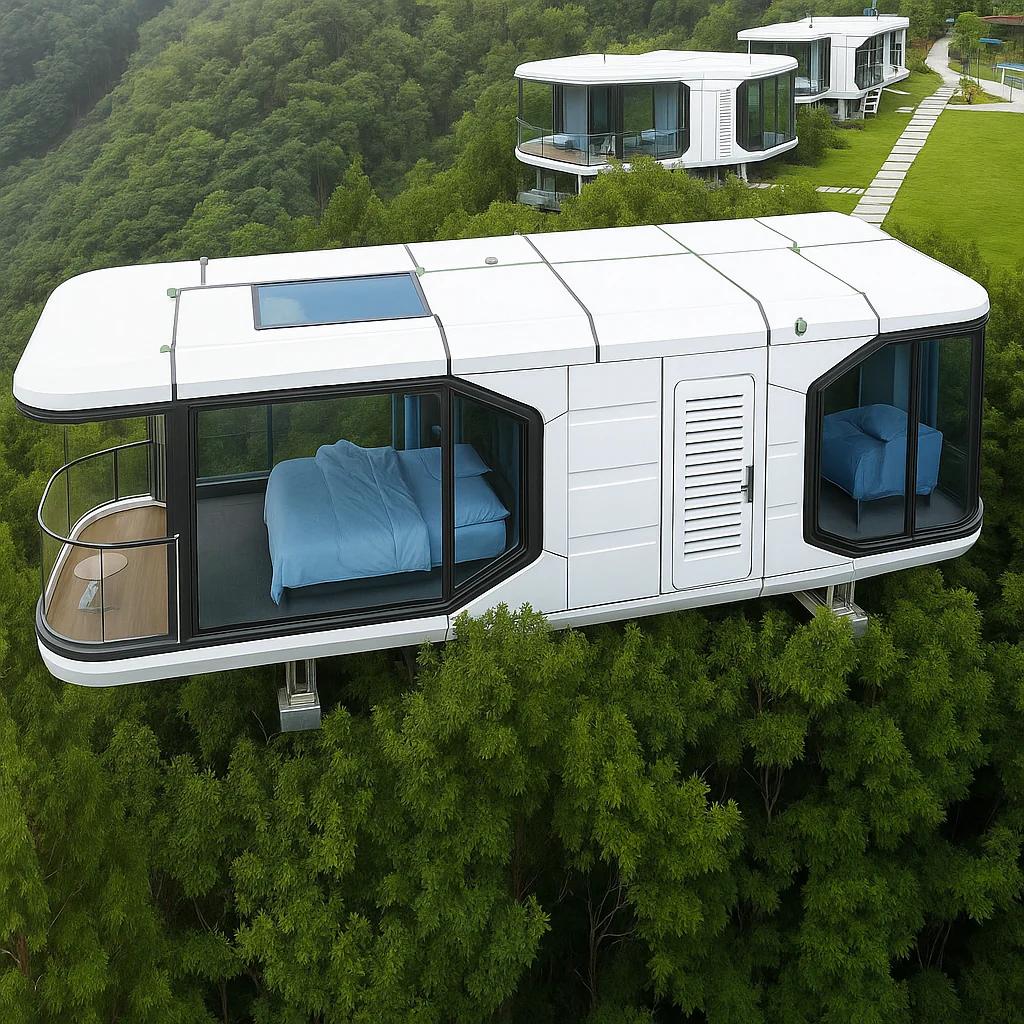
Outdoor off-grid prefabricated capsule house modular housing
WEIGUAN Capsule House Technical Specifications
An off-grid capsule is not a capsule with a solar panel on the roof. It is a unit where every load, every litre and every waste stream has been accounted for before the design is fixed — because on a remote site there is no grid to lean on when the estimate is wrong.
Start with the load, not the panel count
A 38 m² unit with LED lighting, a small fridge, a fan, a laptop and a water pump draws very little. Air conditioning is the exception: it can be half the total demand on its own. So the first decision is not how much PV to buy, it is whether the unit will be air conditioned, and if so for how many hours.
- No air conditioning, temperate site: 2 to 3 kWp PV and 5 to 8 kWh of lithium storage covers a 38 m² unit comfortably.
- Air conditioning, hot site: 5 to 8 kWp and 15 to 20 kWh, plus a larger inverter for the start-up load.
- Winter heating: a heat pump is far more efficient than resistive heating, but it is still the dominant load in a cold climate. Insulation quality and glazing specification matter more than generation capacity.
The solar-powered capsule guide and the off-grid system design guide both work through the sizing in detail. Tell us at order stage that the unit is off-grid and the electrical installation is configured for a DC distribution board and an inverter-charger rather than a grid feed — retrofitting that into a finished wall is expensive.
Water
Two options, and the choice is usually made by the site rather than by preference. A storage tank filled by delivery suits sites with vehicle access; a bore or a rainwater harvest suits sites without. A 38 m² unit with two guests uses roughly 150 to 250 litres a day, so a 2,000 litre tank is about a week of autonomy — enough that a delivery schedule has slack in it.
Insulate and shade the tank. A tank in direct sun in a hot climate grows things.
Waste
Three streams, three answers. Greywater from the shower and basin goes to a soakaway or a planted bed. Blackwater goes to a composting toilet or a package treatment plant, depending on the sensitivity of the site and the local rules. Kitchen waste is a solids trap plus the same soakaway. On a protected site the composting route is usually the only acceptable one, and it changes the bathroom specification — tell us before the order, not after.
Site logistics
Remote sites are where the flat-pack format earns its place. Panels go on a trailer, a pick-up or a farm vehicle for the last few kilometres; an assembled pod needs a road. A levelled pad or screw piles means no concrete lorry has to reach the site, which on a mountain or a wetland is often the deciding constraint.
The envelope — insulated composite panels, Low-E glazing, aluminium and galvanised steel — is rated to wind level 12 and seismic intensity 9 with a 50-year design life, and it is specified for exactly this use: exposed, unmanaged, and far from a maintenance team.
What to send us
Latitude, the worst-case month, whether the unit is air conditioned, the water source and the waste strategy. That is enough to configure the unit correctly at the factory. The off-grid guide covers the equipment; the extreme climate deployment guide covers cold, heat and wind exposure.